Whether you’re a contractor planning a plumbing line, a builder finalizing structural work, an industrial buyer sourcing for a project, or a homeowner getting a water line installed — one question comes up almost every single time: should I use MS pipe vs GI pipe?
The two pipes look nearly identical on a supplier’s shelf, are made from the same base material, and are often confused by first-time buyers. But they are manufactured differently, priced differently, and — most importantly — are meant for different jobs. Choosing the wrong one can mean rusted lines, discolored water, or a structural fitting that fails ahead of schedule. This guide breaks down everything you need to know before you place your order.
Click for Best Prices
What Is MS Pipe?
MS (Mild Steel) pipe — also called black pipe — is manufactured from low-carbon steel with no protective surface coating. It is produced using the ERW (Electric Resistance Welded) process, where a flat steel strip is rolled into a tube shape and welded along the seam using high-frequency electric current, then sized and cut to length.
Manufacturing standards:
- IS:1239 Part 1 — for sizes up to 6″ NB
- IS:3589 — for 8″ NB and above
- IS:4923 — for square and rectangular MS sections
Key properties:
- Carbon content of roughly 0.05% to 0.25% by weight — low enough to keep the steel ductile and weldable
- Manufactured in three thickness classes: Class A (Light), Class B (Medium), and Class C (Heavy)
- No corrosion resistance — bare steel will begin to rust within weeks if left exposed to moisture or humidity
- Produced in grades such as Fe 330, Fe 410, and Fe 450 depending on strength requirement
Where MS pipe is commonly used:
- Structural fabrication — columns, gates, staircases, sheds, industrial frames, tubular poles
- Fire-fighting sprinkler and hydrant mains (usually Class B or C, since these lines run full of water under pressure but are typically indoors/painted)
- HVAC ducting supports and general fabrication
- Gas and fluid transport in industrial plants, where the pipe is usually coated externally
- Any application where the pipe will be painted, powder-coated, or otherwise protected after installation
What Is GI Pipe?
GI (Galvanized Iron) pipe starts life as the exact same MS pipe — same steel, same ERW process — but goes through one additional, critical step: hot-dip galvanizing. The finished pipe is dipped into a bath of molten zinc, which bonds to the steel surface and forms a protective layer as per IS:4736.
This zinc layer is a sacrificial barrier — it corrodes before the underlying steel does, which is what gives GI pipe its long service life in wet or exposed conditions.
Manufacturing standards:
- Base pipe: IS:1239 / IS:3589 (same as MS)
- Galvanizing: IS:4736 (zinc coating thickness and quality)
Key properties:
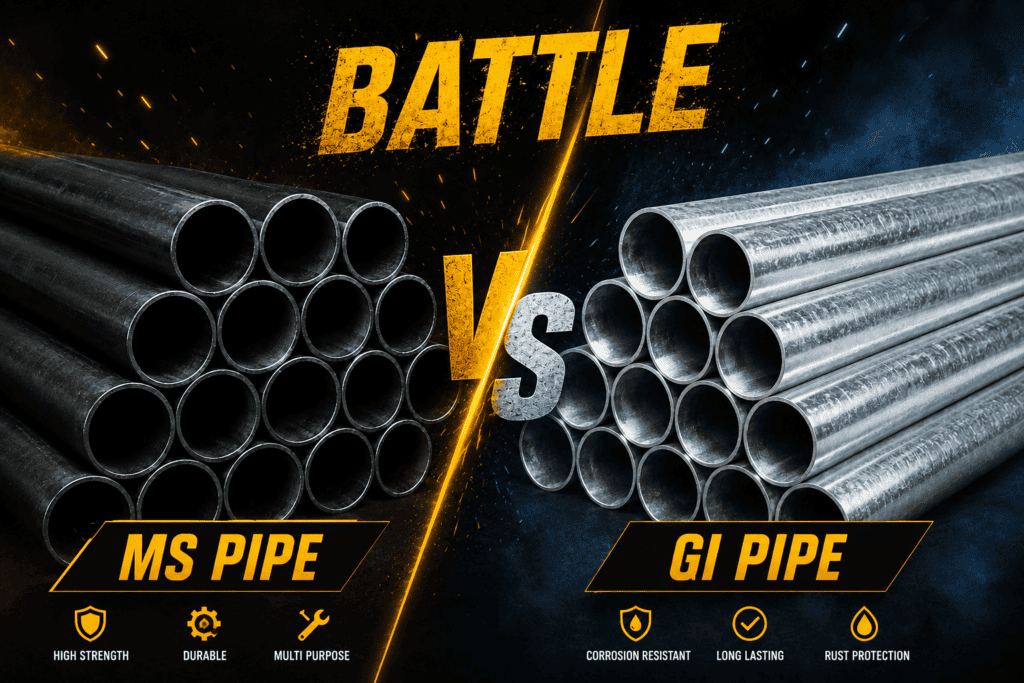
- Distinct silver-grey finish — easy to visually identify against black MS pipe
- Corrosion resistant for years, even in constant water contact or humid environments
- Slightly heavier than MS pipe of the same size, due to the added zinc layer
- Costs more than MS pipe per metre/kg — the galvanizing process adds to both material and processing cost
Where GI pipe is commonly used:
- Domestic and commercial water supply lines — both indoor risers and outdoor distribution
- Plumbing lines embedded in walls or buried underground, where repair access is difficult
- Outdoor structural work exposed to rain and weather
- Borewell casing and agricultural water lines
- Any application where the pipe cannot be easily repainted or maintained over its lifetime
MS Pipe vs GI Pipe — Full Comparison Table
| Parameter | MS Pipe | GI Pipe |
|---|---|---|
| Surface | Bare/black steel | Zinc-coated (galvanized) |
| Corrosion resistance | Low — rusts without external protection | High — resists corrosion for years |
| Cost per metre | Lower | 15–25% higher on average |
| Weight | Lighter | Heavier (zinc coating adds mass) |
| Weldability | Excellent — standard site welding | Reduced — welding burns off zinc coating locally, needs re-coating (cold galvanizing spray) at the joint |
| Appearance | Black/dark grey | Silver-grey |
| Typical lifespan (exposed to moisture) | 2–5 years without paint | 15–25+ years |
| Governing standard | IS:1239 / IS:3589 | IS:1239 / IS:3589 + IS:4736 |
| Best suited for | Structural, fabrication, fire-fighting mains | Water supply, outdoor and buried lines |
check out: Jindal MS & GI pipes in Delhi
Understanding Pipe Classes (Applies to Both MS pipe vs GI pipe)
Both MS pipe vs GI pipe under IS:1239 come in three wall-thickness classes. This is a separate decision from MS-vs-GI, but buyers often mix up class with material type, so it’s worth covering here:
- Class A (Light) — thinnest wall, lowest cost. Used for low-pressure, non-critical lines such as low-rise domestic plumbing.
- Class B (Medium) — the most commonly used class for general building water supply and standard plumbing.
- Class C (Heavy) — thickest wall, used for fire-fighting mains, high-pressure lines, borewell casing, and structural applications carrying real load.
A quick example of how thickness affects weight (approximate, for a 2″ NB pipe):
- Class A: ~2.65 kg/m
- Class B: ~3.23 kg/m
- Class C: ~3.87 kg/m
Heavier isn’t automatically “better” — using Class C where Class B would do just adds unnecessary cost. The right approach is to match the class to your actual pressure rating and load requirement, which your plumbing consultant or structural engineer should specify.
Why GI Pipe Costs More — and When It’s Worth It
The galvanizing process adds real cost: zinc as a raw material, the dipping process itself, and additional handling. This is why GI pipe is priced roughly 15–25% higher than MS pipe of the same size and class.
Here’s the practical way to think about it: a plumbing line that rusts out in 3–4 years means re-excavation, re-plumbing, and disruption — costs that dwarf the small upfront saving from using MS pipe where GI was needed. For any line carrying water or exposed to weather, the extra cost of GI pipe is one of the cheapest insurance decisions you can make on a project.
Conversely, using GI pipe where MS would do — for example, structural fabrication that will be painted anyway — is an unnecessary expense, since the paint already provides the corrosion protection that galvanizing would.
Common Buyer Mistakes
- Using MS pipe for water lines to save cost. This is the single most common mistake on residential and small commercial sites. It almost always leads to rust-colored water, reduced flow due to internal corrosion buildup, and pinhole leaks within a few years.
- Welding GI pipe without re-coating the joint. Welding burns off the zinc layer at the joint, leaving that spot exposed to corrosion unless treated with a cold-galvanizing compound afterward. Many site welders skip this step.
- Ignoring pipe class. Ordering “2 inch GI pipe” without specifying Class A/B/C often results in the supplier sending whichever class is in stock — which may not match your pressure requirement.
- Not checking the ISI mark and BIS licence number. Especially in bulk/project orders, always confirm the pipe carries a valid ISI stamp and ask for the BIS licence number and test certificate for that batch.
Which Brands to Choose
Once you’ve decided between MS and GI, the next decision is brand. In the Delhi NCR market, Jindal Star and Jindal Hissar are the two most trusted and widely approved names for both MS and GI pipe:
- Jindal Star (manufactured by Jindal Pipes Limited, with plants in Ghaziabad, Nagothane, and Bellary) offers sizes up to 20″ NB, making it a common choice for larger infrastructure and water transmission projects.
- Jindal star pipe price list 2026
- Jindal Hissar (manufactured by Jindal Industries Pvt. Ltd., Hissar) has strong project-approval history for fire-fighting lines and structural fabrication, alongside its standard MS/GI range.
- Jindal hissar pipe price list 2026
Both are ISI-certified and accepted on virtually all government and private project tenders. In practice, the choice between the two often comes down to current site stock and pricing rather than a meaningful quality gap.
FAQ.1
Can GI pipe rust at all? Yes, eventually — the zinc coating is sacrificial and wears down over time, especially in highly acidic water or aggressive environments. But under normal conditions, GI pipe will outlast MS pipe by well over a decade in wet applications.
Is GI pipe safe for drinking water? Yes, GI pipe is the standard material for domestic water supply across India and conforms to relevant IS standards for potable water use. That said, for very old GI installations, occasional testing is advisable as coatings degrade over decades.
Can I convert an MS pipe line to GI later? No — you’d need to replace the pipe itself, since galvanizing is done at the factory, not on-site (aside from small touch-up sprays at weld joints).
Which is cheaper to transport — MS or GI? MS pipe is lighter and slightly cheaper to transport in bulk. GI pipe’s added zinc weight marginally increases freight cost, especially on large orders.
Do I need different fittings for MS vs GI pipe? Yes — GI pipe typically uses galvanized fittings (to avoid mismatched corrosion rates), while MS pipe uses standard MS/forged fittings that will usually be painted along with the pipe.
FAQ.2
How do I tell MS pipe and GI pipe apart just by looking at them? GI pipe has a distinct silver-grey, slightly dull shine from the zinc coating. MS pipe is plain black/dark grey with no shine. If you scratch the surface lightly, GI pipe shows a brighter zinc layer underneath; MS pipe shows the same dark steel colour throughout.
Is GI pipe more expensive in the long run, or just upfront? Only upfront. Over a 15–20 year period, GI pipe almost always works out cheaper than MS pipe for water/outdoor use once you factor in the cost of repairs, leak fixes, and re-plumbing that a rusted MS line would eventually need.
Can MS pipe be used outdoors if I paint it well? Yes, for structural applications (gates, sheds, railings) a good quality anti-rust primer plus paint, reapplied every few years, works fine. For water-carrying lines, painting the outside doesn’t protect the inside of the pipe from water contact, so GI is still the right choice.
What size and class should I use for a residential water line? Most residential plumbing uses ½” to 1″ GI pipe in Class B (Medium). Class A is sometimes used for very short, low-pressure branch lines, but Class B is the safer default for main supply lines.
Does Lakshmi Pipe Store provide test certificates with bulk orders? Yes — for bulk and project orders, we provide manufacturer test certificates and BIS licence details for the batch supplied, so you have documentation for project approvals and quality records.
Final Word
There’s no universally “better” pipe between MS and GI — only a better fit for your specific application. As a simple rule of thumb: if it will carry water or face the weather, go GI. If it’s structural and will be painted or coated, MS pipe does the job at a lower cost.
At Lakshmi Pipe Store, we stock both MS and GI pipes from Jindal Hissar and Jindal Star, across all standard sizes (½” to 12″+) and classes (Light, Medium, Heavy), with same-day WhatsApp quotes at current market rates.
Need pipes for your next project? 📞 Call/WhatsApp: +91 97110 03224 📍 Lakshmi Pipe Store, 2863 Hauz Qazi, Chawri Bazaar, Delhi